
Homeowner Guides
What to Do Immediately After Water Damage in Your Home
A practical guide to safety, stopping a leak, documenting water damage, contacting a restoration company, and understanding the next steps.
Hi, I'm Jason from Encore Construction. We regularly walk into homes where the leak itself was small. The homeowner noticed a wet spot, decided it could wait, and called two weeks later. By then there was rot in the subfloor, and the insurance company refused to pay for that part.
I wrote this guide so that doesn't happen to you. It covers what to do in the first 24 hours of home water damage, what happens after you call a restoration company, what you'll be asked to sign, and which questions to ask before you hire anyone, including us.
Quick Takeaways:
- Shut off the main water valve first if you can reach it safely
- Contact a restoration company promptly and notify your insurer according to your policy; report what you observed without guessing
- Don't wait to report a leak, because rot can develop over time, and your insurer may refuse to cover the additional damage
3 Things You Should Do in the First 24 Hours After Water Damage
When water damage occurs, it's easy to panic, especially if your home is actively flooding. You might rush into an area that's not safe or make decisions that could complicate your insurance claim. And in all that stress, it's easy to forget that damaged floors, walls, and cabinets can be replaced. Your safety is much more important.
So if the leak is somewhere you can't safely reach to shut off the water, or the water smells like sewage, please don't take any chances. Give us a call instead. We'll help you figure out what to do next.
First: Stop the Water Source if It's Safe
Water damage can happen anywhere in your home, from a burst pipe under the sink to a broken supply line behind a wall, and the first thing I'd recommend is taking a look around your home, but only if it's safe to do so. If you can identify the source of the water and safely reach the shutoff valve, like under a sink, go ahead and turn it off. If the valve under the sink doesn't stop the leak, you may need to shut off the main water supply. The main shutoff is usually in the garage, in a utility closet, or out at the street. If you can't find yours, call us and we'll help you track it down over the phone. The sooner you can safely stop the water, the better. But sometimes the leak is hidden inside a wall or somewhere you can't reach. That's not something you should try to fix yourself. You're better off calling a professional.
And I really want to emphasize the safety part here. When you're dealing with water all over the floor, even reaching a shutoff valve can be dangerous. Let's say you can see where the leak is, but there's standing water between you and the valve. Don't try to walk through it to get there. You don't know if there could be an electrical hazard. Get yourself and your family out of the affected area and stay out until help arrives.
Second: Call for Restoration Help and Notify Your Insurer
Contact your insurer promptly, following the notification requirements in your policy. A restoration company can help document the loss and start safe mitigation; there is no need to delay either call.
We work with insurance companies every day, but we work for you, and we know what documentation they need to review a claim. And believe me, there's a lot of paperwork involved. We take photos, document the damage, prepare detailed estimates, and handle the back-and-forth communication with your insurance company. You don't have to spend hours trying to figure all of that out yourself. Contact us promptly for an assessment, while also notifying your insurer as your policy requires. We'll assess the damage, explain what needs to happen, and guide you through the insurance process step by step, so your insurer has clear evidence to review. Coverage decisions remain with your insurer under your policy.
Our inspection is completely free, and if you need help right away, a project manager may be able to get to your home in as little as 30 minutes, depending on availability and your location. And if you've already called your insurance company but nobody has shown up yet, give us a call anyway. We can still help.
Third: Take Photos and Videos Before You Move Anything
I understand wanting to save your belongings, but give it five minutes first. Photos taken before anything is moved are the hardest ones to get later, and your insurance company will want to see them. If you've already moved things, don't worry. Tell us what you moved and where it was. Your policy may require documentation and other duties after a loss. Our project manager also photographs and measures the damage during the free inspection. If you're waiting for us and want to do something useful, though, this is it.
Here's what I'd shoot in this order:
- where the water came from, including the part that failed if you can see it
- the walls and floors, especially water lines on drywall, wet baseboards, and flooring that has started to lift
- your belongings where they stand, like soaked furniture and electronics
A slow video walk through each room works just as well as photos, and you can talk over it to say what you're looking at. Don't worry about making it look good. You only need to show what the place looked like before cleanup started.
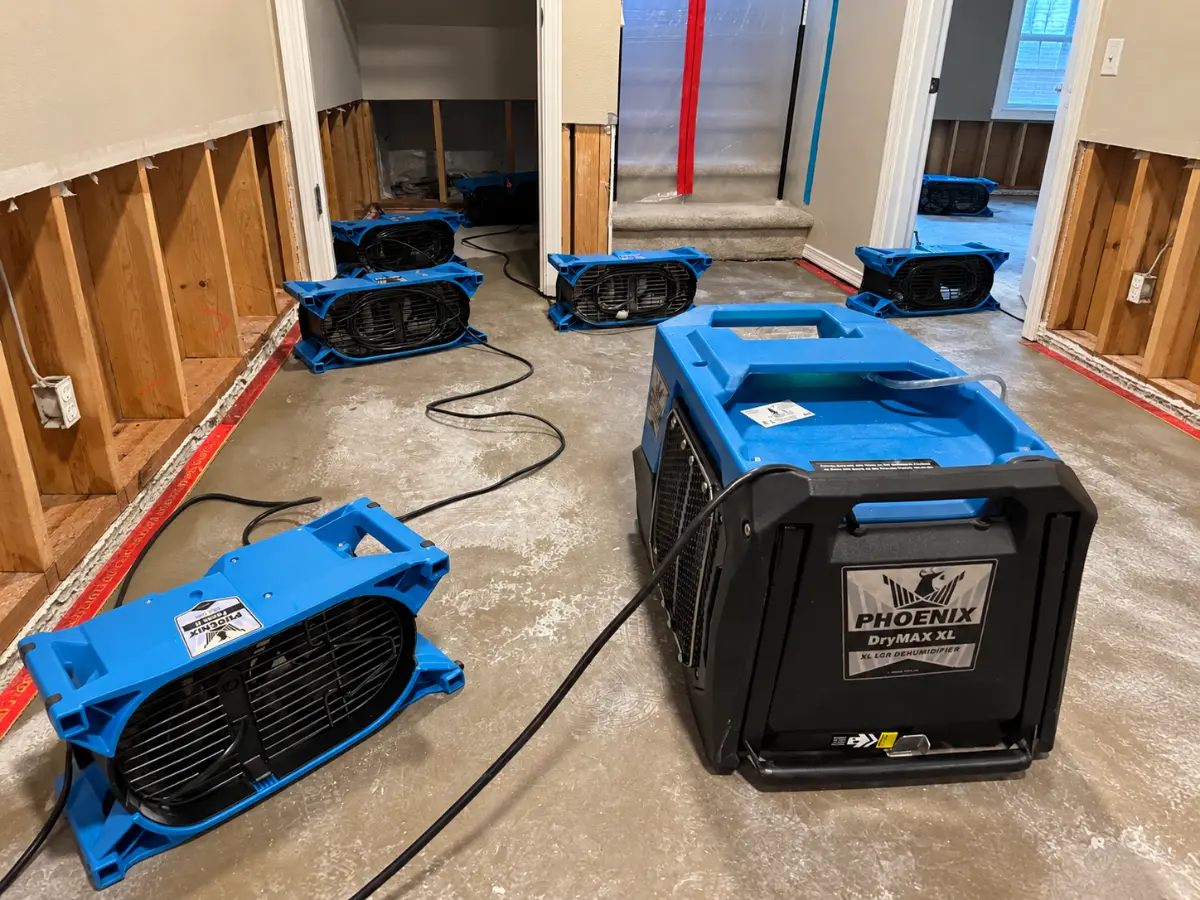
On a recent project in Renton, a supply line failed under a kitchen sink and sent water across the floor of a second-floor apartment. Before anyone decided what had to be torn out, our project manager, Andrew Melnik, photographed the kitchen and the failed line exactly as he found them. Only then did Andrew begin water extraction, removing standing water before setting up an LGR dehumidifier to start drying. He continued taking moisture readings to track the drying process and determine which materials could be saved and which needed to be removed. Those decisions were based on the actual condition of the materials, not guesswork.
The photos and moisture readings also became part of the project documentation, giving the insurance company a clear record of the damage and the work performed. This is exactly why we document everything from the beginning. It helps us explain what was necessary and support the insurance claim with evidence.
Why the First 24 Hours Matter So Much
Water spreads faster than most homeowners realize, and even a small amount of water can cause problems far beyond where the leak started. While the puddle on your floor sits there looking harmless, it's soaking down into the subfloor and climbing up into the drywall. Left alone, that moisture can turn into structural damage. You can't see hidden water damage just by looking at the floor, and some hidden damage may not become obvious until materials begin to swell, warp, or soften.
Your house will start telling you within hours if you know what to look for. A door that closed fine yesterday begins to stick. A floor that looked perfectly normal in the morning starts to lift at the seams by evening. Mold can begin to grow within 24 to 48 hours when materials stay wet, which is why the EPA recommends drying affected areas as quickly as possible.
So when we tell you to call on day one, we're not rushing you for our sake. The same leak is a much smaller job on the first day than it is on the third. Less material has to come out, the drying goes faster, and you get your home back sooner.
Can You Fix Water Damage Yourself?
Sometimes we arrive at a home and find that the homeowner has already tried to handle the water issues themselves. It doesn't happen all the time, but we do see it. The problem is that cleaning up the water you can see doesn't necessarily solve the bigger issue. And there's another reason I don't recommend doing repairs yourself. Any work you do before the damage has been properly documented can make things more complicated with your insurance company.
So my advice is simple: if you can safely reach the shutoff valve, turn off the water. That's the one thing I'd really encourage you to do yourself. Leave the cleanup and repairs to a professional restoration team. Specialists in professional water damage restoration know how to assess and document the damage properly before starting any work.
What Happens After You Call
Most homeowners have never been through a restoration job, so here is what to expect. The first call goes to our office, where we take down the details and pass them to a project manager, usually Matt or Andrew. They call you back and drive out. From there, the work moves through six stages.
Stage | How long it takes | What happens |
|---|---|---|
Free inspection | One visit | The project manager measures and photographs the damage, explains the plan, and tells you what to expect from your insurer |
Protecting the home | The first hours on site | A two-person crew moves furniture, covers the floors, and hangs plastic barriers so dust stays out of the other rooms |
Demo of wet material | About two hours on a small job, a couple of days on a bigger one. Complex losses, safety requirements, or access restrictions can take longer | Anything too wet to save comes out |
Drying | 3 to 5 days on a typical job | Drying equipment runs until the moisture readings say the materials are dry |
Insurance approval | Often one to two weeks; carrier review can take longer | Our insurance team sends the file and handles the back-and-forth with your adjuster |
Rebuild | Three weeks or more | Our own crews put everything back. Special-order cabinets can add months |
Your home's materials change these numbers more than its size does. Laminate countertops and sheet vinyl come out fast, while granite and tile have to be broken out by hand. A condo floor with gypcrete over plywood needs 7 to 8 days of drying where plain plywood needs 3. That's why two kitchens of the same size can be very different jobs.
What You'll Sign and What You Should Get Back
The hardest moment for most of our customers is the first day, when someone hands them a contract while their floor is still wet. You should know what's in front of you. The first document is a work authorization, which gives us permission to start work in your home. Read it, and ask about anything you don't understand before you sign.
After that, the paperwork grows fast. A claim file includes line-item estimates and a long email thread with your adjuster, plus thousands of job-site photos by the end. Our in-house insurance team builds that file and sends it to your insurer. You're entitled to see it, so ask for a copy. We give one to any customer who wants it.
Five Questions to Ask Any Restoration Company
You may be reading this from outside our service area, or you may want to compare us with someone else. Either way, ask these before you sign with anyone:
- Do you use your own crews or subcontractors? With subcontractors, you end up juggling several companies you didn't choose.
- Who handles the insurance paperwork? Ask what documents they provide and which tasks remain your responsibility.
- Who do you work for, me or my insurance company? Ask how recommendations, scope changes, and payments are handled. You have the right to select your own contractor.
- Is your team IICRC-certified? That's the industry certification for water damage work.
- Is the inspection free? You shouldn't have to pay to find out how bad the damage is.
Mistakes We See Homeowners Make, and What They Mean for Your Claim
We're all human, and when you're dealing with something as stressful as home water damage, mistakes happen. But making a mistake doesn't mean your insurance claim will be denied. In many cases, it just slows things down, especially if you're trying to handle everything on your own. That's why it's important to work with us or another restoration professional who understands how insurance companies handle these claims.
Here are the ones we see most often, and what each one usually means for your claim.
The mistake | Deal-breaker for your insurer? | What to do now |
|---|---|---|
Waiting two weeks to report the leak | Sometimes, for part of the claim. Your insurer may cover the original leak and refuse to pay for the rot that built up while you waited, so report the damage on day one. | Call anyway. We document what the leak caused and what came after, and make the case for everything that should be covered. |
Guessing out loud on the first call to your adjuster | Usually not, but a casual "probably a while" is hard to correct once it's in the file. | Tell us what you said. We go back to the insurer with photos and moisture readings. |
Assuming you have to use the crew your insurer sends | No. You have the right to select your own contractor, including when an insurer recommends one. | If nobody has been sent out yet, call the company you want. |
Spending the insurance check that was mailed to you | Not for the insurer, since they've already paid. It becomes a problem when the invoice arrives. | Tell your contractor right away. With us, we'll sit down and work out a way forward. |
Hiring a company that leaves the paperwork to you | No, but missing documentation may lead to questions and additional follow-up. | Ask them who builds the claim file before work starts. |
If you've already made one of these, call us and tell us exactly what happened, including the parts you'd rather not mention. We can help document the loss and explain the next steps, but cannot guarantee coverage or a claim outcome. It will probably take longer than a clean claim would have, and you won't be doing it alone.
Need Help With Water Damage?
Give us a call. We're a local, family-owned water damage restoration company, not a franchise, and we handle everything in-house, from water removal and drying to dealing with your insurance company and rebuilding your home. We serve homeowners across Skagit, Snohomish, King, Whatcom, and Island counties.
We're available 24/7 for emergency water damage restoration, and our project manager can arrive in as little as 30 minutes, depending on your location and availability. The inspection is completely free. We'll explain what's happening, walk you through the next steps, and help restore your home from the initial drying through the rebuild. If your belongings need to come out during the work, we pack them and keep them in our 13,000-square-foot warehouse until your home is ready.
Contact Encore Construction and let us help you through it.
FAQ
How Long Can You Wait After Water Damage Before Taking Action?
There really isn't a good reason to wait. Mold can begin growing within 24 to 48 hours when wet materials are not dried, and the risk of mold growth increases the longer moisture remains trapped inside floors and walls. Water can also continue spreading into materials where you may not see it. The most important steps to take immediately are to shut off the water source if it's safe, document what happened, and contact a restoration company. Acting early can prevent further damage and give the restoration team a clearer picture of what can still be dried and saved.
What Should I Do if Water Damage Happens while I Am Away from Home?
We get a lot of these calls around Thanksgiving and other holiday trips. If you discover water damage after being away, don't assume you're dealing with clean water. First, check whether the water is still flowing, and shut it off only if you can do so safely. Avoid contaminated water, document the damage, and remove water only when it is safe to do so. Contact a restoration company.
What Are the Common Causes of Water Damage?
Failed pipes and supply lines are the number one cause we see, usually due to aging or poor installation. Appliances come second, mostly water heaters, dishwashers, and washing machines. After that, we see accidents, like a tub left running or a DIY faucet swap gone wrong. In winter we also get a lot of frozen pipes and heavy-rain flooding.
Can I Stay in My Home during Restoration?
It depends on how much water entered your home, which areas were affected, and what type of water you're dealing with. If there's major water damage, contaminated water, or water near electrical outlets or equipment, it may not be safe to stay. We'll assess the situation and help you understand when it's safe to return to the affected areas.
How Can I Prevent Water Damage from Happening Again?
Have shutoff valves and supply lines checked regularly. Do not force a stuck valve; have a plumber inspect valves that stick or leak. Ask about aging or brittle pipes, including CPVC where present. Construction year alone does not establish pipe material or condition.
What Should I Do if I'm Dealing with Water Damage but Can't Afford Repairs?
First, don't assume you'll have to pay for everything yourself. Our owners estimate that about 95% of our jobs involve insurance claims. Deductibles, exclusions, limits, and any uncovered work determine what a homeowner pays. If you don't have coverage, tell us up front, because we offer a discount for homeowners who pay on their own. Our inspection is free, so you can find out how serious the damage is before making decisions. We can't promise what your insurance will cover, but we can help you understand your options and what needs to happen next.
Can Encore Handle the Full Home Restoration After Water Damage?
Yes, and that's one of the biggest reasons homeowners choose us. We handle everything in-house, from the initial cleanup and drying to reconstruction, and our owners estimate that about 95% of our mitigation customers also use us for the rebuild. You won't have to find a separate contractor to rebuild your kitchen or replace damaged flooring. Our team handles the entire process, which makes it easier to protect your home from further damage and get things back to normal without coordinating several different companies.