
Homeowner Guides
How to Document Water Damage for Insurance Claims in Snohomish County
Learn what to photograph, record, and keep for a water damage insurance claim in Snohomish County, including contractor records and county forms.
The water is off and your phone is in your hand. What do you photograph first? Does the wet carpet have to stay where it is? And what happens if you already cleaned up, or threw something out, before you thought about a claim at all?
Much of our work is in Skagit and Snohomish counties, and our owners estimate that about 95% of our jobs involve an insurance claim. Coverage depends on the policy. I have watched claims stall because an important photo was never taken, and seen homeowners resolve documentation gaps by knowing what to send next. I wrote this guide for property owners and business owners who want a complete file, from the first photo to the day the claim closes. It also covers documentation when a county or utility may have caused the loss.
Quick Takeaways:
- Washington claim-response deadlines change on October 18, 2026; check the applicable rule and keep dated records. Source guidance.
- A claim against a local government cannot go to court until 60 calendar days after it has been presented
- A destroyed property claim with the county assessor can be filed up to three years after the loss
Who Will Ask for Your Documentation
More than one office may want your file, and each one wants a different slice of it. Knowing the audience tells you what to collect.
Who | What they want | Timing |
|---|---|---|
Your insurance company | Photos, an itemized loss list, and proof of what things cost | The same day you find the loss |
A government body or utility, if it caused the loss | A signed claim form with supporting bills | Before any lawsuit, with a 60-day wait |
The county assessor | A destroyed property claim form | Within three years |
Your flood carrier | A signed proof of loss | Generally within 60 days; confirm any applicable extension |
Your contractor | Access and your early photos | The first visit |
One file serves all five. Your insurance company reads it to decide what the policy owes. A public body reads it to decide whether it caused the loss. The assessor reads it to decide what the house is worth while it is torn apart. None of them was in the room when the pipe broke, so the file has to stand in for you.
If you remember one rule, make it this one: collect once, copy often. Every item below goes into a single folder on your phone and a single paper envelope, and each office gets a copy from there.
What to Record in the First Hour
Start at the water source if it is safe. Photograph the failed part where it sits, then the wall or cabinet around it. If a plumber removes the part, ask whether it can be kept safely, labeled with the date. The failed part and a dated invoice can help document the cause; they do not establish coverage by themselves. Work through affected areas one room at a time, with wide shots from the doorway and close-ups of wet surfaces. Include a tape measure for scale. Photograph the ceiling below the wet room too, even if it looks fine.
Photos and videos do different jobs, so take both. A photo freezes one detail. A slow video walk shows how the rooms connect and where the water traveled, and you can talk over it to say what you are looking at. Leave the timestamp on and never edit the originals.
Document every item where it stands before it is lifted. The U.S. Fire Administration gives disaster victims two rules that apply here as well. Do not throw damaged goods away until they have been listed, and expect to be asked for an inventory of damaged items showing the quantity, a description, and what you paid. Photograph serial numbers and the labels on the back of anything electronic.
Sometimes you cannot do this safely. If water is near outlets, stay out and shoot from the doorway. If you are out of town, ask a neighbor to take the same photos and text them to you, so the timestamps sit in your message thread. If you can do none of it, call us. Our project manager photographs and measures everything on the first visit, and that visit is free.
What Your Contractor Records, and What to Ask For
Your photos show what you saw. A professional restoration crew records hidden moisture and the work performed. Ask in writing for copies of the records relevant to your job.
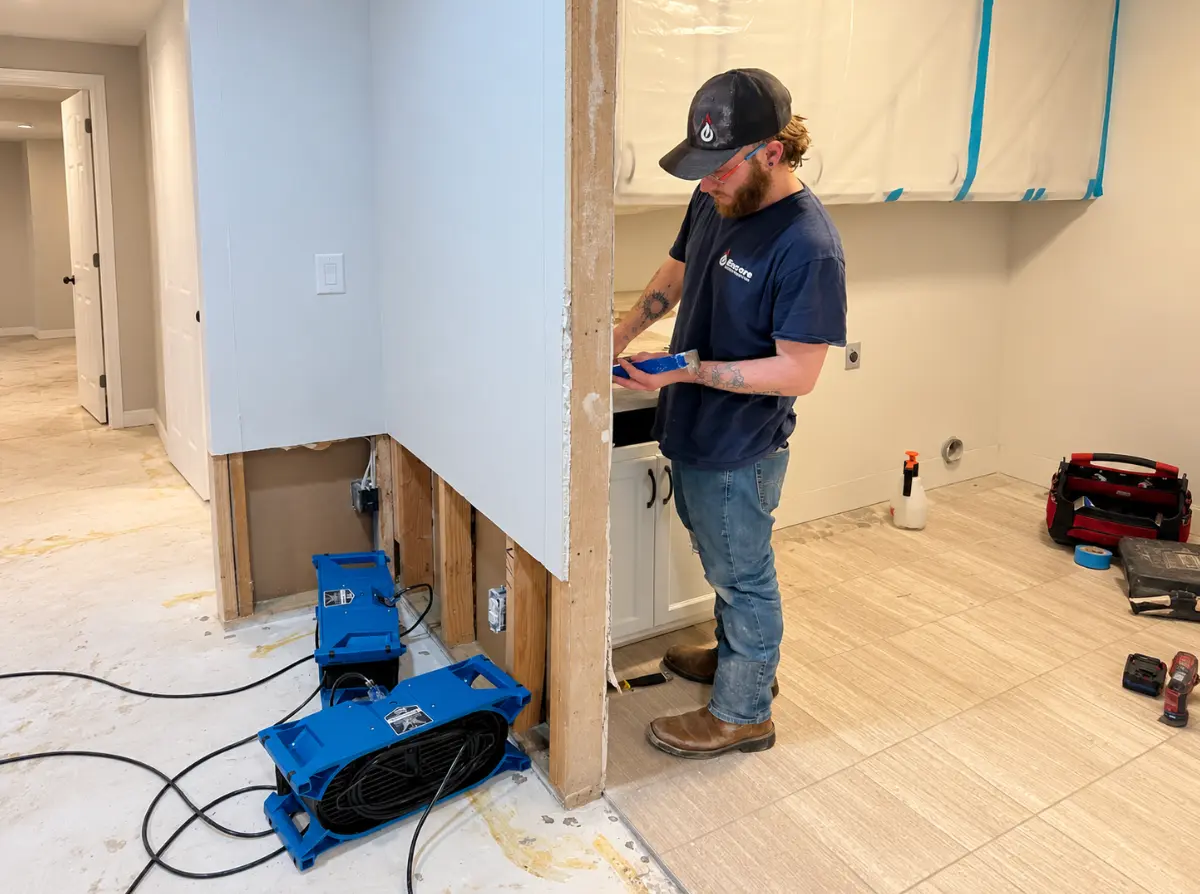
Our project manager, usually Matt or Andrew, starts with a free inspection. He measures the wet rooms and photographs them with a tape in the frame. Moisture readings map the extent of the damage behind the paint, which lets him assess the damage wall by wall. If the water reached framing or another structural part of the house, that gets its own set of photos and notes.
From there the file grows quickly. It holds a line-item estimate, a work authorization, correspondence with your carrier, and job-site photos. Our technicians record moisture readings during monitoring, which helps explain drying decisions. The Gypsum Association notes that moisture meters can help compare wet areas with dry ones. Ask about the training and certifications of the crew assigned to your job, and request the records you need to understand the scope.
Ask for three things in writing. Ask for the readings from the first day. Ask for the moisture log when the equipment leaves. Ask for a copy of the full file at the end, which we give to any customer who wants it. If you worked with another company and it never gave you records, request them by email so the request itself is dated. Your own photos will fill the gap in the meantime.
How to Keep the File Complete Until the Job Closes
A claim file is not finished on day one. Most of the gaps we see open up in the second and third week, when the emergency is over and people stop writing things down.
Anything removed from the house should be photographed before it leaves where safe. Demolition can begin quickly, so document early. Additional damage found behind a wall goes into the file when it is found, with a photo and a note on its location. The scope and duration of demolition depend on the loss.
Save every receipt for a hotel or a meal if you have to leave. The insurance commissioner notes that many policies include some coverage for emergency shelter when a home is uninhabitable, and that coverage is paid based on documentation. The same office recommends a log of every conversation about the claim, with the date, the name, and what was said.
Keep a copy of every check and every letter that comes with it. We have had customers spend a payment without knowing it was meant for the rebuild. Ask what each one covers before you use it.
If you missed a week of the log, rebuild it now. Your call history, your texts, and your email all carry dates. Write the entries from those and mark them as reconstructed. A late log that says so is still far better than none.
What Your Insurance Company Does With the File, and What to Do When It Pushes Back
Insurance companies decide from what is on paper. A water damage insurance claim follows the same pattern as most property damage insurance claims: you report, someone looks, and a decision comes back based on the file.
Most insurance policies carry a notice clause, and many policies require you to protect the home from further loss while you wait. Tell your insurer the date you found the water and what failed. If you do not know how long it was running, say so and offer the photos.
Insurance companies may send someone to inspect the loss. Washington rules generally require the investigation to be completed within 30 days after notification, unless it cannot reasonably be completed in that time; this is not a promise of a visit within 30 days. Answer requests for additional information in writing and keep a copy. Policy exclusions for ongoing seepage may affect coverage, so retain evidence of the source and when you discovered it. Source guidance.
Good documentation does not inflate anything. It helps you maximize what the policy already owes you and reach a fair settlement without months of argument.
Know your rights if the company goes quiet. Individual-policy claims generally require acknowledgment within 10 working days (10 business days under the rule effective October 18, 2026). Until October 18, the settlement rule generally requires acceptance, denial, or a notice explaining the need for more time within 15 working days after fully completed proofs of loss. From October 18, the rule generally uses 30 calendar days after notification of a claim, with written reasons if more time is needed and further notices when required. A denial must be in writing. If you have concerns, contact Washington’s Office of the Insurance Commissioner at 1-800-562-6900 with your dated records. Source guidance.
Flood damage runs on its own track and may require separate flood insurance. NFIP proof-of-loss documentation is generally due within 60 days of the flood unless an applicable extension changes the deadline. Confirm the requirements and current deadline with your flood insurer. Source guidance.
When the County or a Utility May Be Responsible
Some losses start outside your property line. A county storm drain backs up, or road work sends runoff into a crawl space. A utility crew breaks a main. In those cases a second claim may exist next to your own.
Snohomish County is self-insured for this kind of liability. Its official website explains that, in accordance with RCW 4.96.020 and county code, a Claim for Damages has to be filed with the Risk Management claims staff in the Finance Department. The form is a paper document that must be signed, and it can be mailed or dropped off at the county campus in Everett.
The county generally asks for two repair estimates, or the paid bill and receipt if repairs are already complete. Keep those with your photos and other supporting records. After a completed claim is received, the county acknowledges it and investigates whether it accepts responsibility. An accepted claim may proceed to settlement; a denial does not establish what your own insurance policy covers. Source guidance.
You are not stuck if the answer is no. The county’s own question page says you can contact the person who denied the claim, or the county’s risk manager directly, to raise your concerns. You can also ask for a status at any time by calling 425-388-3956. State law sets one more marker: no lawsuit can begin until 60 calendar days after the claim was presented.
Other public bodies have their own filing procedures and designated agents. Identify the organization alleged to have caused the loss and check its instructions; being inside a city does not by itself establish which body is responsible.
A damage claim against a public body does not replace your own policy. Report to your carrier first, tell them a third party may be involved, and let both run. To substantiate either one, you need the same photos and the same bills. I am a contractor and not a lawyer, so on a large loss I would get a consultation with an attorney before signing anything with a government office.
The Assessor Form Most People Miss
A badly damaged home is worth less until it is rebuilt, and your property tax can reflect that. The county assessor accepts a Destroyed Property Claim Form that requests a reduction in assessed value. State rules allow it to be filed within three years of the loss.
The assessor will want to see what was lost and when. Your dated photos and the contractor’s scope answer both questions. The state’s guidance adds a useful detail: the assessor sets the value of the destroyed portion before the rebuild starts, so file early if you can. If you only learn about the form after the work is done, file anyway, because the three-year window is still open.
If You Have Already Made a Mistake
Almost everyone gets something wrong in the first two days. Very few of these mistakes end a claim. The table shows the ones we see most and what to send next.
What happened | What to do now |
|---|---|
You cleaned up before taking photos | Photograph what remains today, such as stains and swollen baseboards. Get the plumber’s dated invoice. Moisture readings will still show how far the water went |
You threw damaged items away | Rebuild the list from memory, room by room, as the insurance commissioner suggests. Add bank statements and order emails as proof of purchase |
You guessed about timing on the first call | Send a short written correction with your photos attached. Our team follows up with the readings |
You waited days or weeks to report | Report today. The file should separate what the original leak caused from what came later |
You have no proof of what things cost | Old photos of the room help. So do card statements and retailer accounts |
You signed a form you did not understand | Ask for a copy. The state regulator warns that an assignment of benefits can hand your claim decisions to a contractor |
The company has stopped answering | Count the working days against the state rules above, then call the commissioner’s office |
One habit prevents most of this next time. The National Association of Insurance Commissioners offers a home inventory app that lets you walk through the house and photograph each room. Twenty minutes with it now replaces a week of reconstruction later.
What Goes Into the File at Each Stage
A file built in order is easy to hand over. The table shows what to add as the job moves along.
Stage | Add to the file |
|---|---|
First hour | The source, the rooms, and your belongings on camera |
First day | The call log and the contractor’s first readings |
Mitigation | Photos of everything removed |
Drying | The moisture log |
Rebuild | Written approval for every change |
Closing | A copy of the full file and the assessor form |
Following this order is the simplest way to streamline a claim. Nobody has to wait for a paper that was never made, and nobody has to take your word for anything.
Let Encore Build the File With You
Unexpected events do not come with instructions. Encore Construction is a family-owned restoration company, and our emergency response line is answered 24/7. We start recording swiftly, before the first wet board is touched.
Our in-house team prepares the paperwork and walks you through the repair costs line by line. Then our own crews fix the building. Water damage restoration done this way gives you a smooth recovery and one company to call until you get your property back to normal.
Before you hire anyone, ask who builds the claim file. With us, the answer is that we do, and you get a copy.
FAQ
Is hiring a public adjuster worth it?
Sometimes. The state regulator describes a public adjuster as a licensed person who works on your behalf to appraise and negotiate a claim. On a large or disputed loss that help can matter. A complete file makes it less likely you will need one.
Can I throw ruined things away once they are photographed?
Photograph and inventory damaged items first where safe, and ask your insurer what it needs before disposal. Do not keep items that pose an immediate health risk. Flood guidance advises promptly discarding hazardous flood-damaged items after documentation. Source guidance.
Do phone photos count?
They do. Keep the originals unedited and back them up the same day, so a lost phone does not take the claim with it.
What if the water came from a neighbor’s property?
Build the same file and report to your own carrier. State guidance notes that your company can sometimes recover from the neighbor’s insurance when the neighbor was at fault.
How long should I keep the file?
Keep it at least until the claim is closed and the assessor’s three-year window has passed. I would keep it for as long as you own the house, because a buyer may ask what was done.
Does the county’s form ask me to name a dollar amount?
Yes. The county’s form includes a line for the amount you are claiming. Use the figures from your contractor’s paperwork, and do not guess. State law adds one reassurance: the amount written on that form cannot be used as evidence at trial.
Who builds the file if I rent my home?
Both of you should document what was affected. A landlord’s policy may cover the building and a renter’s policy may cover personal belongings, depending on the policies. Photograph your belongings and send the landlord written notice, keeping a copy. Confirm coverage with the relevant insurer.